
Particle-size testing standards define required metrics, methods, and reporting for regulatory compliance. They emphasize median diameters (D50), D10–D90, span, mean, mode, and variability measures with uncertainty, calibration, and traceability. Wet methods (laser diffraction, DLS, sedimentation) mandate dispersion, sonication, and validation details. Dry powder and sieving standards specify sample prep, mesh selection Particle Size Analyzer, and instrument settings. Guidance helps select appropriate reference materials and documents results for audits. Continue for practical implementation and examples.

Key Particle-Size Metrics Regulators Expect
When evaluating particle-size data, regulators focus on a concise set of metrics that demonstrate control, reproducibility, and safety https://laballiance.com.my/. The discussion centers on median diameters (D50), distribution breadth (D10–D90, span), and specific percentiles that indicate fines or oversized fractions.
Consistent reporting of mean and mode complements percentile data for different distributions. Metrics for variability—standard deviation, coefficient of variation, and batch-to-batch comparisons—are required to show process stability.
Reporting limits, detection ranges, and measurement uncertainty ensures transparency. Traceable calibration, method validation outcomes, and acceptance criteria enable freedom to innovate within defined boundaries.
Clear, objective metrics allow manufacturers to optimize formulations while meeting regulatory expectations for predictable performance and consumer protection.
Wet-Method Standards (Laser Diffraction, DLS, Sedimentation)
How are wet-dispersion techniques applied to particle-size analysis and why do regulators scrutinize their protocols? Wet-method standards govern suspension preparation, dispersant choice, ultrasonic energy, and concentration to guarantee reproducible laser diffraction, dynamic light scattering (DLS), and sedimentation results.
Regulators focus on preventing agglomeration, altering surface chemistry, or introducing shear that skews size distributions. Validated procedures specify sample handling, instrument settings, and verification with reference materials.
Laser diffraction yields broad-range distributions; DLS targets submicron mobility-based sizing; sedimentation applies for density-differentiated separations.
Reporting must include dispersion medium, sonication parameters, temperature, and dilution factors. Clear traceability and method qualification enable comparability across labs while preserving analytical freedom to select appropriate wet techniques for specific materials.
Dry-Powder and Sieving Standards (ISO/ASTM, Laser Dry)
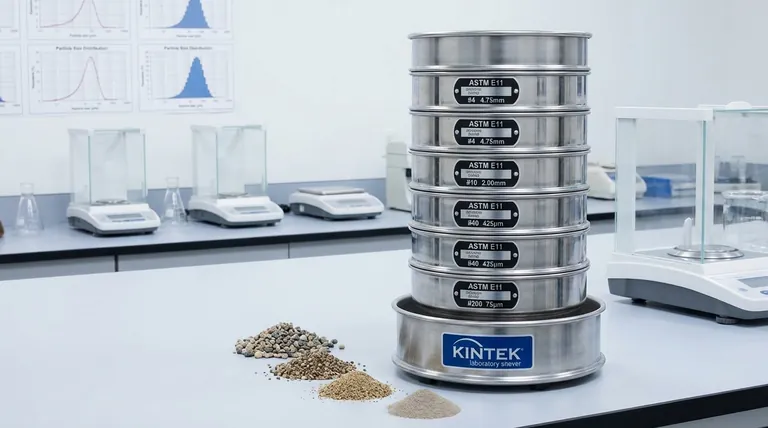
Dry-powder and sieving standards establish controlled procedures for particle-size analysis of bulk powders where wet dispersion is impractical or would alter material properties. These standards, defined by ISO and ASTM, prescribe sample preparation, instrument calibration, and measurement protocols for sieving and laser dry systems.
Sieving standards detail mesh selection, stack vibration, and evaluation of retained fractions, enabling reproducible fractionation.Laser dry methods specify dispersion energy, optical settings, and data reporting to account for agglomeration and flow behavior without liquids. Emphasis lies on traceable procedures, uncertainty estimation, and clear reporting of D10, D50, and D90 metrics.
Such standards empower operators to characterize powders consistently while preserving material integrity and maintaining comparability across laboratories and suppliers.
Choosing the Right Particle-Size Standard for Your Sample
Having established the framework of sieving and laser dry protocols, selection of an appropriate particle-size standard depends on the material’s physical properties, the chosen measurement method, and the intended use of the data.
The analyst evaluates particle shape, hardness, hygroscopicity, and tendency to agglomerate to match standards that mimic sample behavior. Method compatibility guides whether to use sieving-calibrated reference sieves, optical size standards, or suspension-based calibration materials.
Traceability to recognized institutes (ISO, ASTM, NIST) guarantees comparability, while selection of narrow versus broad size-distribution standards reflects required resolution.
Practical constraints—available instrumentation, sample throughput, and acceptable preparation—narrow choices. The objective is a standard that yields meaningful, reproducible measurements enabling autonomous interpretation and confident downstream decisions.
Documenting and Reporting Particle-Size Results for Audits
A clear, auditable record of particle-size testing captures the methods, materials, calibration references, measurement data, and quality controls necessary to demonstrate compliance and enable independent verification.
The report should state sampling plans, instrument models, software versions, operator IDs, and environmental conditions.
Calibration certificates and traceability to standards must be attached or referenced.
Raw data, processing steps, and uncertainty estimates are required, alongside acceptance criteria and any deviations with justification.
Visuals—histograms, cumulative distributions, and instrument output—support transparency.
Version-controlled templates and electronic signatures preserve integrity while allowing autonomous review.
Reports should enable others to reproduce results or challenge them, empowering stakeholders to act without gatekeeping.
Concise, consistent documentation reduces dispute and fosters operational freedom.
Conclusion
In conclusion, regulators expect clear reporting of particle-size metrics, with established wet- and dry-method standards guiding compliant measurement. Selecting the appropriate standard depends on sample properties and intended use, whether laser diffraction, DLS, sedimentation, sieving, or dry-laser techniques. Thorough documentation of methods, calibration, and data presentation ensures reproducibility and audit readiness. Adherence to recognized ISO/ASTM protocols and transparent reporting reduces regulatory risk and supports consistent, defensible particle-size characterization.